
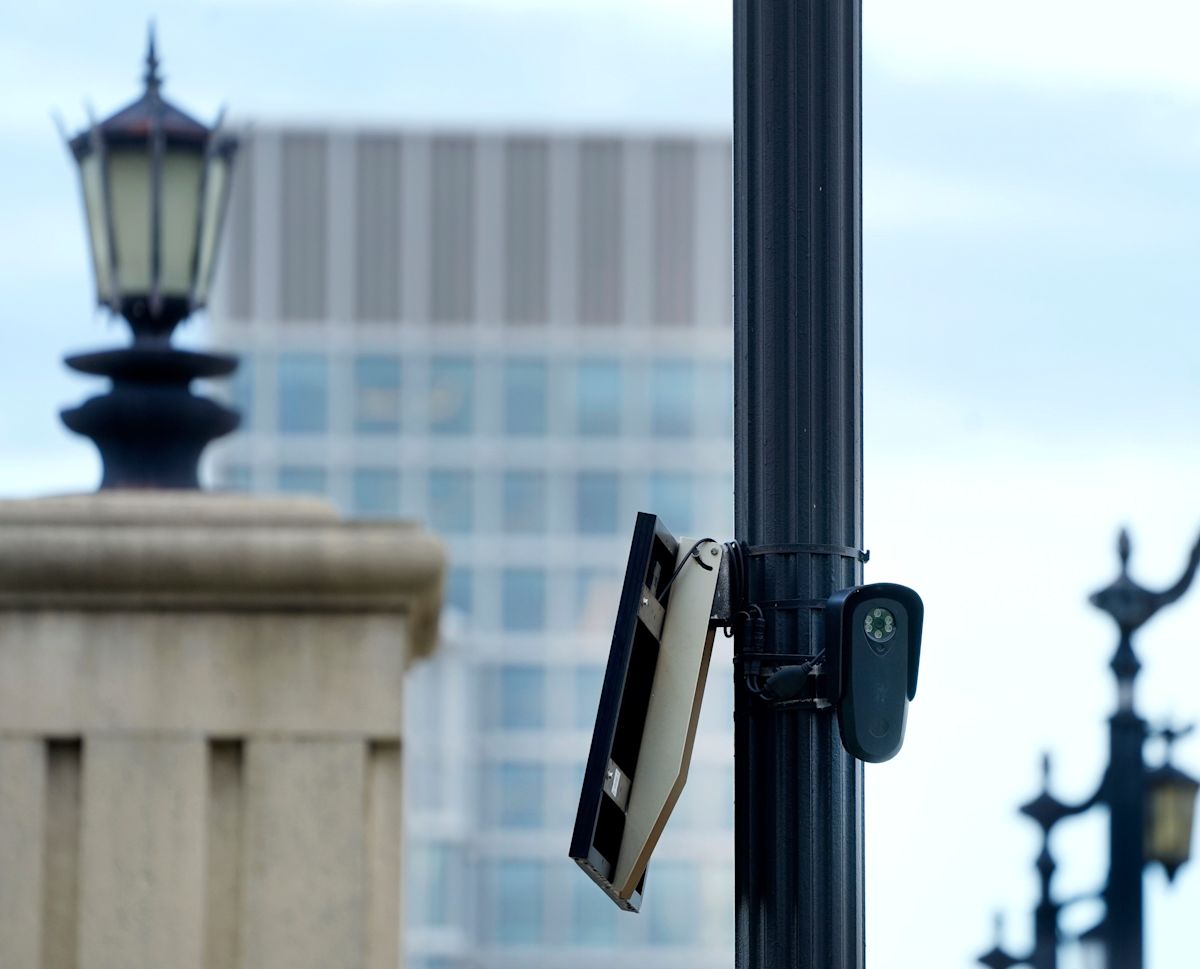
A recent statewide regulatory shift has brought the widespread use of automated license plate readers into sharp focus across Alachua County. Following a state directive revoking permits along major travel corridors, local leaders and residents are examining how law enforcement balances high-tech investigative tools with the privacy rights of everyday drivers. The policy debate has intensified as community members call for structured oversight rather than piecemeal jurisdictional adjustments.
The changes stem from an Aug. 31 decision by the Florida Department of Transportation, which moved to revoke its general use permits for automated license plate reader devices positioned within state highway rights-of-way. As part of the administrative action, state officials gave regional law enforcement agencies a 30-day deadline to remove the affected equipment from these transportation corridors.
In Alachua County, Sheriff Chad Scott reviewed the local network and identified 27 automated license plate readers that met the state transportation department's criteria for removal. While these 27 highway-adjacent units were designated to be taken down in accordance with the state mandate, numerous other plate-scanning devices situated outside state highway rights-of-way remain active and in service throughout the community.
The sudden removal order intersected with an ongoing local review led by Sam Cornell, an independent researcher and organ recovery surgical coordinator living in Gainesville. Cornell spent the summer reviewing public records to analyze the county's automated license plate reader program, focusing on how the system is managed, funded, and permitted. One of the primary unresolved questions during his research was whether the county had valid state permits on file for the highway cameras.
Before the state issued its directive, Cornell addressed the Alachua County Commission to formally request a deeper evaluation of the surveillance initiative. Speaking from the podium, he emphasized that his goal was not to dismantle the camera system entirely. Instead, he urged local officials to establish firm operational guardrails to govern how automated data is handled and overseen across the county.
During his presentation to the five-member commission, Cornell outlined specific measures needed to protect public privacy. His proposed framework included shortening the duration that captured license plate data is retained, instituting independent and authentic system audits, creating full transparency regarding which agencies and individuals can access the database, and providing a public accounting of total program costs.
The Alachua County Commission responded positively to the recommendations, with all five commissioners agreeing that the license plate reader network deserved a much closer look. The local government's willingness to review the program signaled growing acknowledgment that automated surveillance requires established public policies to ensure accountability.
Advocates for the technology emphasize that automated plate readers serve legitimate law enforcement functions. Sheriff Scott has reported that the scanning devices have actively assisted his office in solving serious offenses, including homicides, armed robberies, and missing-person investigations. The systems are also routinely deployed to detect stolen vehicles and aid officers in ongoing criminal investigations.
The investigative utility of the technology is not unique to Alachua County. Cornell noted that neighboring Lake County provided two dozen case summaries highlighting similar successes, illustrating that automated plate readers have played a measurable role in resolving criminal cases across the region. Cornell subsequently published those case summaries as part of his research into the technology's practical applications.
Despite these law enforcement successes, questions persist regarding the sheer volume of information collected on non-suspects. Sheriff Scott acknowledged this concern, noting that the vast majority of vehicles photographed by the cameras belong to ordinary community members traveling to work or driving their children to school. The sheriff affirmed that these citizens are not criminal suspects and should not be treated as such by automated systems.
Sheriff Scott pointed to several fundamental questions that mirror the concerns raised by privacy advocates. According to the sheriff, the most critical issues surrounding license plate readers include determining precisely what information is collected, defining how long that data should be preserved, regulating who is permitted to access the records, and establishing clear legal standards for what constitutes a legitimate search.
Cornell pointed out that while the state transportation department's permit revocation altered where cameras can stand, it did not resolve the core privacy issues. Because the state's action was based strictly on highway right-of-way boundaries, it represents a jurisdictional determination rather than a comprehensive privacy policy. Cameras situated off state routes continue recording motorists under the same existing rules.
The path toward local policy reform has been facilitated by cooperation between researchers and local law enforcement. Cornell commended the Alachua County Sheriff's Office for its openness, noting that the agency promptly fulfilled public records requests within roughly a week and provided the documents free of charge. This transparency has allowed the community discussion to focus on verified records and policy details rather than institutional conflict.
Looking forward, community researchers plan to hold further discussions with representatives from the Alachua County Sheriff's Office to examine program standards in detail. Cornell indicated that he intends to listen to the agency's perspectives and will publicly share any positive findings or constructive solutions that emerge from those conversations.
The overarching debate highlights the tension between rapidly expanding public safety technology and the establishment of civilian oversight. As local and state authorities navigate the aftermath of the state highway removals, community advocates continue to argue that advanced monitoring systems must operate under clear, publicly vetted standards that balance investigative capabilities with the privacy rights of the public.


(0)