
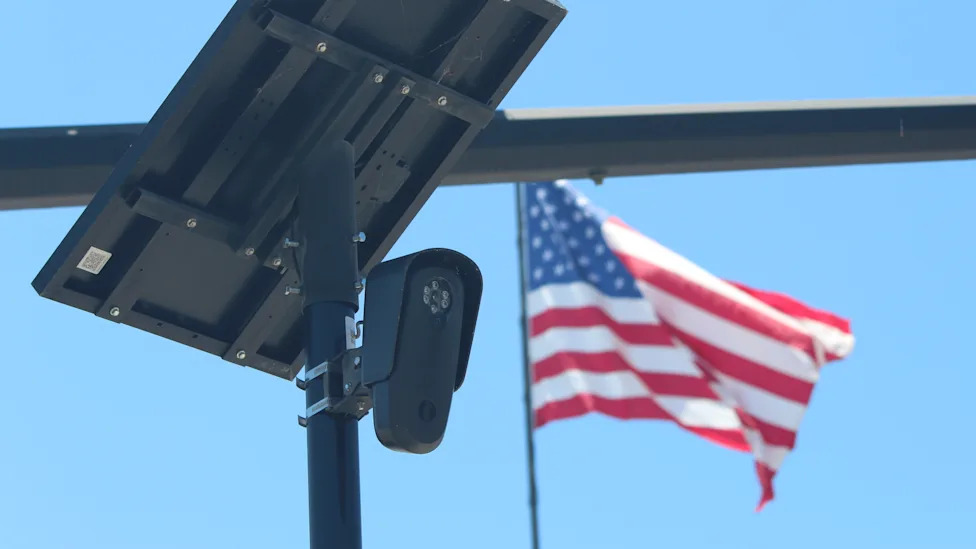
Law enforcement agencies across Ohio’s Miami Valley are actively investigating a spate of vandalism incidents directed at Flock license plate reader cameras. The targeted destruction has brought simmering debates over automated vehicular tracking, governmental surveillance, and personal privacy back into the public spotlight.
The physical attacks against the roadside devices have occurred in multiple neighboring jurisdictions within southwestern Ohio. In the city of Riverside, unidentified individuals targeted a camera installed within a military housing development, forcefully wrenching the unit from its mounting post and leaving it dangling solely by its exposed internal wiring.
A short distance away, another act of deliberate property destruction took place along Kauffmann Road. At that location, perpetrators defaced the surveillance hardware by coating the camera lens in paint and scrawling the protest message "No Flock" directly onto the support pole. The Fairborn Police Department has launched an investigation into the incidents to identify those responsible.
In response to the physical destruction of its hardware, Flock Safety officially condemned the actions. A company representative emphasized that disabling or damaging the camera systems directly undermines neighborhood safety, arguing that the technology exists primarily to protect the very communities where the attacks are taking place.
The acts of destruction have drawn mixed reactions from area residents who are grappling with the expanding presence of monitoring devices in their neighborhoods. David Lutzweit, a resident of Riverside, strongly denounced the property damage, stating that destruction of public infrastructure is fundamentally the wrong method for expressing political or social disagreement.
Lutzweit stressed that community members should pursue legitimate civic channels if they harbor concerns about surveillance tools in their neighborhoods. He argued that citizens should bring their grievances to city council meetings and engage directly with elected representatives rather than resorting to unlawful acts of vandalism, which he characterized as criminal behavior.
At the same time, Lutzweit expressed personal support for the technology, pointing out that license plate recognition serves as a vital investigative aid for local law enforcement. He noted that the automated systems have assisted police departments in resolving numerous criminal cases, adding that giving officers access to modern investigative tools produces an overall positive result for public safety.
The controversies unfolding across the Miami Valley reflect broader national questions regarding the rapid proliferation of automated license plate readers. Flock’s camera systems have expanded aggressively across the country, currently maintaining an operational presence in more than 6,000 communities spread across 49 states, with Alaska remaining the only state without active deployments.
Despite widespread adoption by police agencies, the extensive coverage of these camera networks has sparked significant alarm among civil liberties advocates and elected officials in Ohio. The growing unease over constant location tracking has prompted candidates running for Ohio governor to advocate for stronger regulatory frameworks and statutory safeguards to prevent misuse.
Such privacy concerns have already reshaped municipal policies within the region. Earlier this year, the city of Dayton made the definitive decision to discontinue its use of Flock cameras and completely dismantle its network, citing heightened community pushback regarding surveillance reach and operational accountability.
Regional concerns surrounding the technology have been amplified by documented instances of internal protocol violations. In Dayton, a police officer was forced to resign following an internal affairs investigation, which discovered that the officer had failed to comply with strict departmental regulations governing the authorized use and oversight of the camera system.
Fears over data abuse extend well beyond Ohio's borders, as demonstrated by severe breaches in other jurisdictions. In New York, a sheriff's investigator recently faced criminal charges after authorities discovered she had executed more than 4,000 unauthorized vehicle searches through the Flock database, demonstrating the potential risks when safeguards fail.
Nevertheless, high-ranking state officials continue to champion the public safety benefits of the automated detection systems. Speaking at a law enforcement symposium held in Dayton, Ohio Attorney General Andy Wilson defended the technology, illustrating how real-time vehicle alerts can directly preserve human life during critical emergencies.
Wilson referenced a notable case in Miami County where the automated camera network provided immediate tracking data that enabled officers to swiftly locate and rescue a suicidal individual in crisis. As investigators in Fairborn and Riverside work to identify the vandals, the incidents continue to highlight the delicate balance between high-tech crime prevention and individual civil liberties.





(0)