
Senator Susan Collins is once again deploying her long-standing political playbook across Maine, relying on personal constituent engagement and a proven track record of bringing federal investments home as she seeks to counter shifting political currents. The five-term Republican incumbent is focusing her campaign on the localized impact of her legislative work rather than broad national ideological debates.
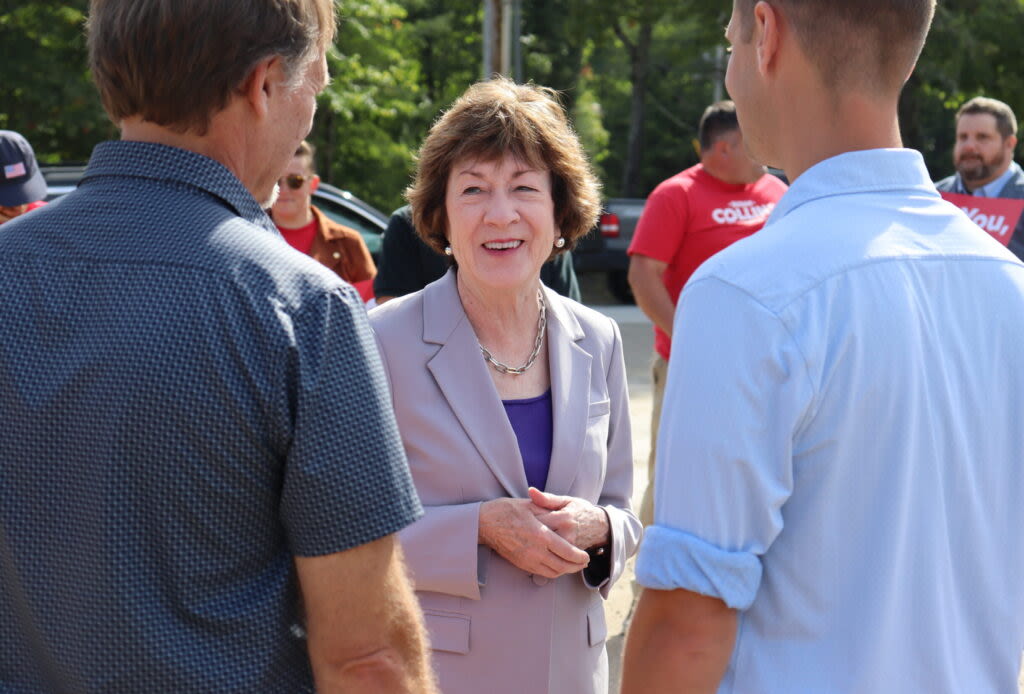
That strategy was clearly on display during a recent campaign stop in Naples, where a tour bus bearing the phrase "Susan Collins Our Senator" arrived at P&K Sand and Gravel, a local enterprise spanning multiple generations. A gathering of roughly 20 individuals, including business owners, community members, and area leaders, assembled with campaign placards to welcome the senator to the facility.
Taking time to engage with attendees individually, Collins inquired about their commercial operations and touched upon shared personal ties. Emphasizing her own background in a family-run enterprise, she praised such operations as foundational to the state's identity, describing them as the true heart and soul of Maine's economy.
These intimate gatherings in community hubs serve as the foundation of Collins’ re-election bid. Throughout her visits to schools, civic organizations, and local commercial establishments, the senator routinely highlights the federal dollars she has secured, as well as specific instances where she moved to recover funding from the administration of President Donald Trump to assist local initiatives.
The focus on legislative longevity appears to resonate across standard partisan divides among some voters. Kevin Rogers, a registered Democrat who backs the Republican incumbent, observed that substantial political tenure is precisely what enables an elected official to effectively deliver resources and make things happen for their constituents.
Collins has made this message central to her campaign advertising and public appearances ahead of the Nov. 3 election. Rather than spending valuable campaign time reintroducing her platform or debating broad national topics, she continues to concentrate on highlighting concrete accomplishments delivered to specific communities while maintaining political distance from Trump.
Her Democratic opponent, Troy Jackson, has presented a sharply contrasting argument to voters. Jackson, a logger hailing from Allagash and a former president of the Maine Senate, contends that Collins’ prominent role in directing federal dollars obscures a legislative record that has proven harmful to the people of Maine over time.
Jackson and his campaign argue that despite her influence as chair of the Senate Appropriations Committee, Collins has overwhelmingly supported policies advanced by the Trump administration. According to the challenger's camp, those federal measures have ended up imposing millions of dollars in costs on Maine communities and working families.
In addition to challenging Collins' voting history, Jackson is navigating significant campaign hurdles, notably Collins' substantial fundraising advantage. Faced with a sizable financial gap and a truncated campaign calendar, Jackson has directed his resources toward an intensive field organization, attempting to build upon the grassroots energy initially generated when former nominee Graham Platner was in the race prior to dropping out.
Meanwhile, Collins’ role as a key legislative leader is being actively tested in Washington during Trump’s second presidential term. As the chair of the powerful Senate Appropriations Committee, she faces immediate high-stakes fiscal responsibilities on Capitol Hill, where the governing party typically encounters significant headwind during midterm cycles.
With just 16 days remaining to negotiate spending measures and prevent a potential federal government shutdown, Collins must navigate urgent legislative business alongside colleagues under tight deadlines, testing her ability to leverage her seniority under intense national scrutiny.
Back on the campaign trail, Collins continues to collect institutional backing from business groups. In Naples, Corey Mitchell, a co-owner of P&K Sand and Gravel, presented Collins with an official endorsement from the National Federation of Independent Business, citing her willingness to work across the aisle.
Mitchell stressed that current national governance requires pragmatic problem-solvers rather than partisan voices who merely criticize gridlock. He commended Collins for focusing on quiet problem-solving in Washington instead of generating rhetorical noise about dysfunction in the capital.
Business owners also highlighted Collins' past legislative accomplishments, particularly her sponsorship of the 2020 Paycheck Protection Program established during the COVID-19 pandemic. Mitchell and his mother, co-owner Colleen Foster, emphasized that the forgivable loan program played a vital role in preventing their company from laying off approximately half of its workforce during severe economic uncertainty.
Foster also cited Collins' intervention in assisting the business with regulatory concerns regarding quarry inspections on their property. This direct approach to constituent service was frequently cited by attendees as a primary reason for their ongoing support of her candidacy.
As the election approaches, Collins is betting that her decades-long reputation as an effective constituent advocate and senior appropriator will once again persuade Maine voters, allowing her to overcome broader partisan dynamics and secure another term in the Senate.


(0)