
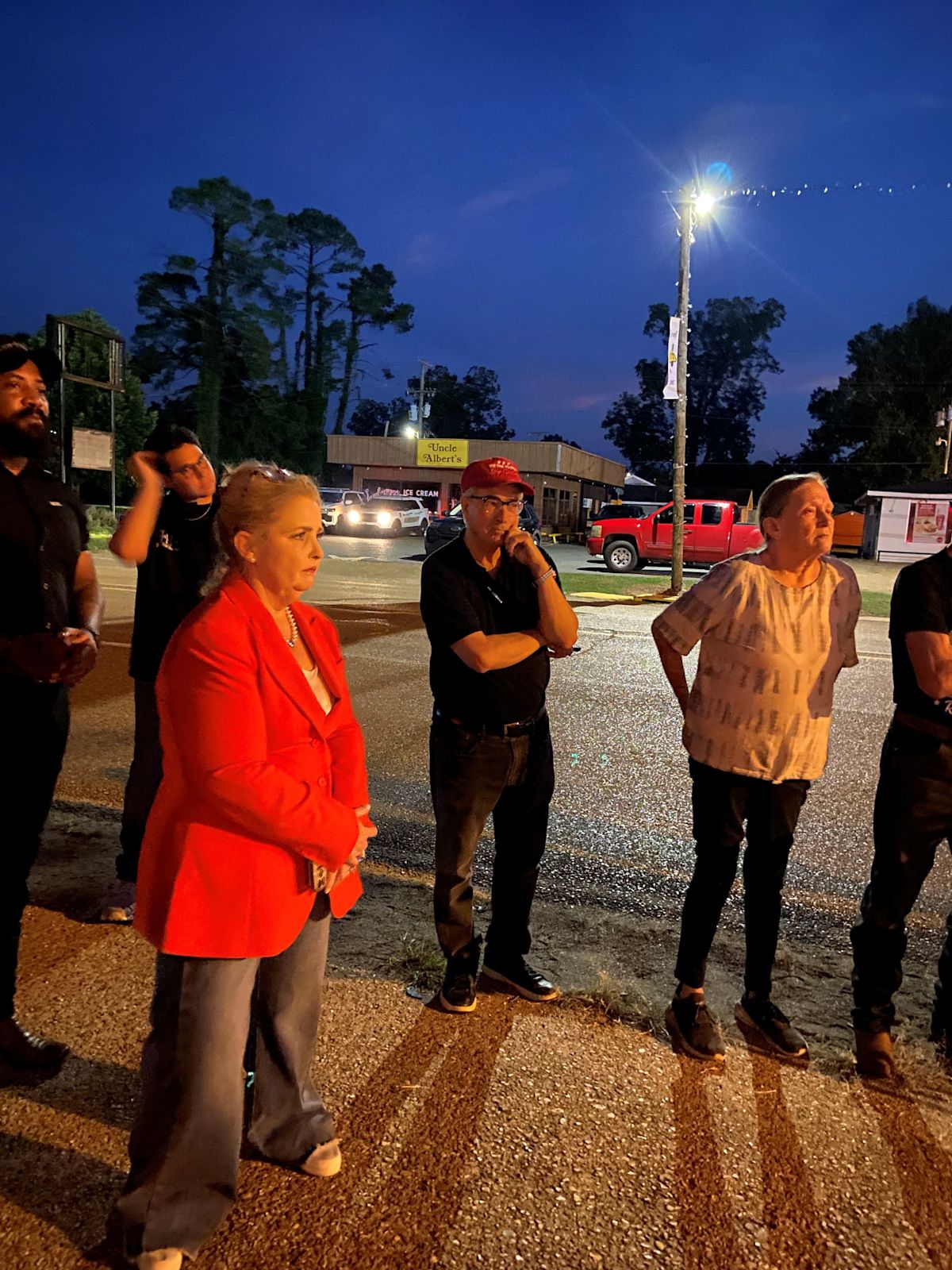
A national advocacy initiative challenging the rapid expansion of artificial intelligence infrastructure brought its message to Central Louisiana over the weekend, rallying local residents against a massive technology project currently underway near the town of Boyce. Addressing a gathering in a local parking lot, organizers asserted that rural communities are systematically being denied a voice regarding the construction of high-consumption computing facilities in their backyards.
The event focused specifically on Data Forge 1, an immense $3.6 billion artificial intelligence factory data center being constructed on former agricultural land just outside Boyce in Rapides Parish. Developed by Dallas-based Applied Digital, the large-scale industrial project has triggered growing apprehension among area residents regarding its long-term footprint, electrical consumption, and overall effect on the rural locality.
The Boyce stop was the latest leg of the nationwide "AI Data Center Revolt" tour, organized under the leadership of Amy Kremer. The multi-city campaign originated in Dallas following the mini Republican convention, completed its initial stop in Austin, and made its way into Louisiana before continuing toward a scheduled conclusion on September 16 in Washington, D.C.
During her remarks, Kremer stressed that her platform is not fundamentally opposed to modern technological innovation or artificial intelligence development. Instead, she argued that the authority to welcome or reject massive computational centers must rest directly with the people living in the affected jurisdictions, rather than being imposed without genuine public consultation.
Kremer told the assembled audience that artificial intelligence represents the most powerful technological advancement in human history. She emphasized that because the technology relies heavily on American land, resources, domestic energy, public data, and taxpayer funds, citizens should not be excluded from shaping its deployment or forced to accept heavy infrastructure without consent.
Outlining the stance of her organization, Humans First—a grassroots conservative entity seeking an "America First" framework for artificial intelligence policy—Kremer explicitly rejected top-down governmental moratoriums. She stated that neither state-level nor federal prohibitions align with the group's philosophy, advocating instead for local governance where residents elect leaders who decide whether to permit, approve, and build such infrastructure.
Tensions surrounding the Boyce development have steadily mounted in recent months. A public informational meeting held in June featured representatives from Applied Digital, the regional economic development body Louisiana Central, and power provider Cleco to outline operational details and parish benefits. However, that outreach effort was largely met with persistent skepticism from residents who felt their fundamental questions were left unanswered.
Prominent among the local speakers at Saturday's rally was Gary Musgrove, the president of Save My Louisiana. His grassroots group, which was established in 2025 to oppose regional carbon capture and sequestration initiatives, has expanded its focus to examine the Data Forge 1 project, specifically probing the immense utility demands associated with operating the facility.
A central point of concern raised by Musgrove is the contract requiring Cleco to deliver 430 megawatts of electricity to the facility. According to Musgrove, that substantial volume of power is roughly equivalent to the electricity needed to supply 250,000 residential homes, representing approximately 25 percent of the utility provider's total output capacity.
Musgrove expressed significant alarm over where the power company will procure such an enormous amount of generation capacity. He questioned whether surrounding areas might face the prospect of hearing nearly 200 generators operating continuously to fulfill the site's energy demands, noting that questions about power sourcing during the June forum were dismissed by project officials as proprietary information.
Potential land use impacts also remain a paramount concern for local activists. While acknowledging that compulsory land acquisition has not taken place so far, Musgrove indicated that fears regarding eminent domain and future property expropriation to build out supportive electrical infrastructure drove Save My Louisiana to scrutinize the project.
The debate in Boyce reflects wider discussions surrounding technology infrastructure. Musgrove highlighted remarks made by President Donald Trump, who observed that while municipalities that oppose data centers risk missing out on valuable economic development opportunities, developers of these intensive facilities should ultimately be responsible for generating their own electrical power supplies.
The rally in Rapides Parish brought together an array of local and regional figures, including attorney Ed Tarpley and area residents such as Dustin McAnn, a rancher and LaSalle Parish resident who commutes to work as an educator in Rapides Parish, all united by shared questions about the project's long-term community footprint.
As the AI Data Center Revolt tour bus departs Boyce for its remaining stops ahead of its September 16 finale in Washington, D.C., local opponents in Central Louisiana maintain that transparent dialogue, power grid protection, and self-determination must take precedence before multi-billion-dollar infrastructure ventures proceed any further.


(0)