
The Witte Museum has launched a comprehensive culinary exhibition titled "Gather 'Round the Table: Texas Food Traditions," offering visitors an engaging exploration of the Lone Star State's diverse foodways and cultural heritage. Open through February 7, 2027, the expansive showcase was organized to mark the museum's 100th anniversary milestone, bringing together rich historical artifacts, custom-built installations, and cultural narratives under one roof.
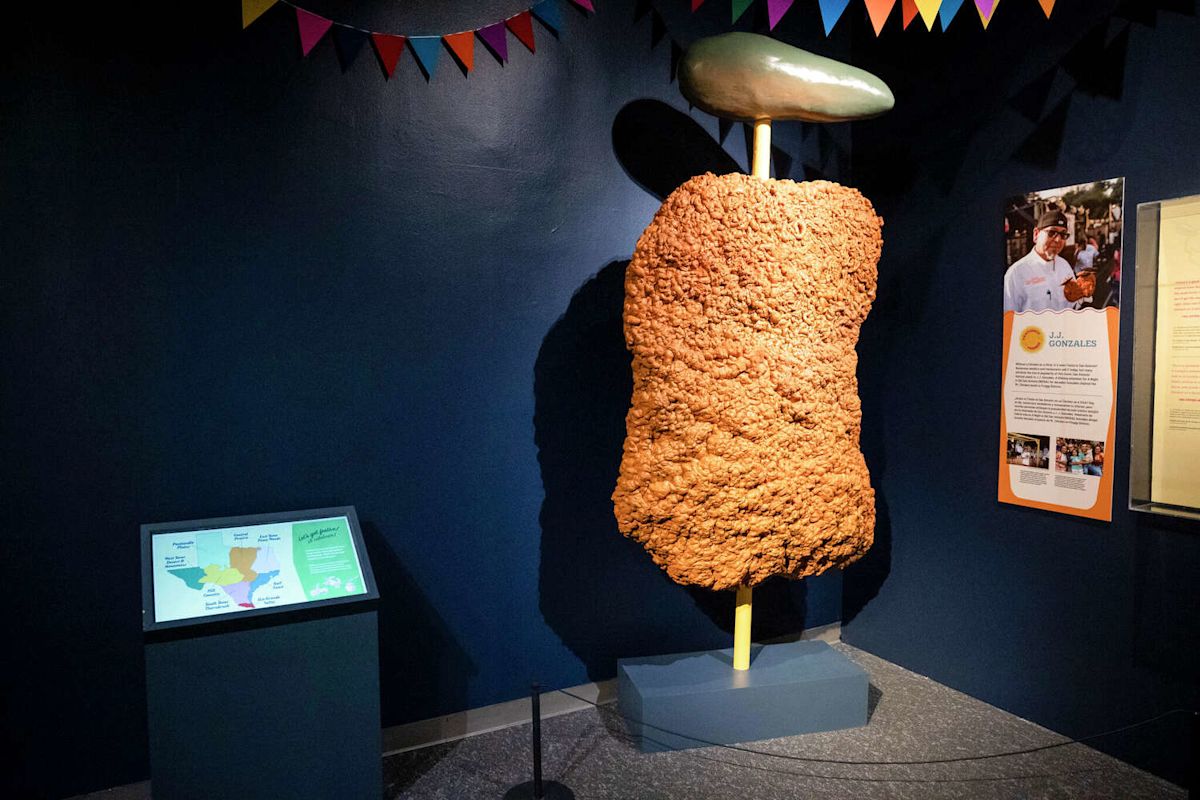
Greeting attendees inside the gallery is an eye-catching, larger-than-life centerpiece: a 10-foot-tall sculpture of a beloved regional festival favorite, chicken on a stick. Complete with a realistic golden-brown textured coating and a plump jalapeño perched atop a bright yellow skewer, the enormous artistic creation instantly evokes the sights and flavors of local celebrations while serving as a prime visual landmark.
Although the towering skewer appears appetizing enough to serve multiple families, it is strictly an artistic fabrication. Marcos Medellin, the director of exhibitions at the Witte Museum, designed and built the piece using ordinary workshop remnants. The realistic sculpture was assembled from scrap wood, chicken wire, structural insulation foam, and a PVC pipe to achieve its distinctive form and texture.
The supersized chicken skewer anchors an area of the exhibition focused specifically on community fairs, festivals, and celebratory gatherings. These communal events have long played an essential role in defining the state's modern culinary identity, showcasing popular grab-and-go treats that bring communities together across generations.
According to Nalleli Guillen, the museum's vice president of interpretation and curator of history, including the iconic snack was non-negotiable for the curatorial team. Guillen noted that when developing the exhibition's festive themes, community members and staff made it clear that omitting chicken on a stick would be an unforgivable oversight in any authentic review of regional celebration food.
Beyond festival snacks, "Gather 'Round the Table" invites patrons to explore the wider everyday traditions and debates that define Texas kitchens. The exhibition thoughtfully examines enduring cultural preferences and culinary arguments, such as the classic choice between corn and flour tortillas, as well as the friendly competition between salsa and guacamole, giving visitors context on what Texans prepare and the historical reasons behind those choices.
Museum executives view the centennial showcase as a major demonstration of the institution's internal talent and extensive archival holdings. Michelle Everidge, president and chief executive officer of the Witte Museum, described the ambitious presentation as a prime example of the institution operating at its peak, emphasizing the significance of generating large-scale, artifact-rich exhibitions entirely in-house to commemorate a century of community service.
In addition to contemporary sculptures and cultural retrospectives, the exhibit highlights significant botanical and historical specimens from the museum's permanent collection. Among these is a rare, early 20th-century shadow box originally curated by naturalist H.P. Attwater, which documents the remarkable diversity of Texas's native nut crops.
While modern consumers might be surprised to learn that more than 1,000 distinct varieties of pecans exist, Attwater dedicated considerable effort to documenting and preserving them. His surviving shadow box, dating to the early 1900s, displays 50 specific pecan varieties organized neatly in sets of three, complete with vintage typewritten labels identifying cultivars like the slender May Russell, the rounded sweetmeat, and the fragile Mexican Papershell.
The pecan showcase carries deep symbolic value for the institution, tying directly into the earliest days of its founding. The artifact is part of the Attwater Collection of Natural History, which served as the museum's very first major acquisition and established the foundation of its permanent historical inventory.
The acquisition was spearheaded by Ellen Schulz Quillin, a pioneering schoolteacher and botanist who went on to establish the museum. Quillin purchased Attwater's comprehensive natural history collection for $5,000, funding the landmark transaction largely through modest pocket-change donations of nickels and dimes contributed by her dedicated students.
When the institution formally opened its doors to the public on October 8, 1926, items from the Attwater collection were among the prominent displays featured in the inaugural galleries. Originally christened as the Witte Memorial Museum, the organization later simplified its official title in 1984 by dropping "Memorial" from its name.
To provide a fully rounded educational experience, the exhibition pairs visual and historical retrospectives with interactive and sensory features. Among these hands-on elements is an aromatic installation that allows guests to encounter and distinguish the distinct scents of eight different culinary spices central to Texas recipes.
Running across several seasons through early 2027, "Gather 'Round the Table: Texas Food Traditions" blends institutional history with broad cultural storytelling. By examining everything from historic agricultural research to contemporary festival delicacies, the exhibition underscores how the evolution of food continues to shape Texas culture a century after the museum's founding.


(0)