
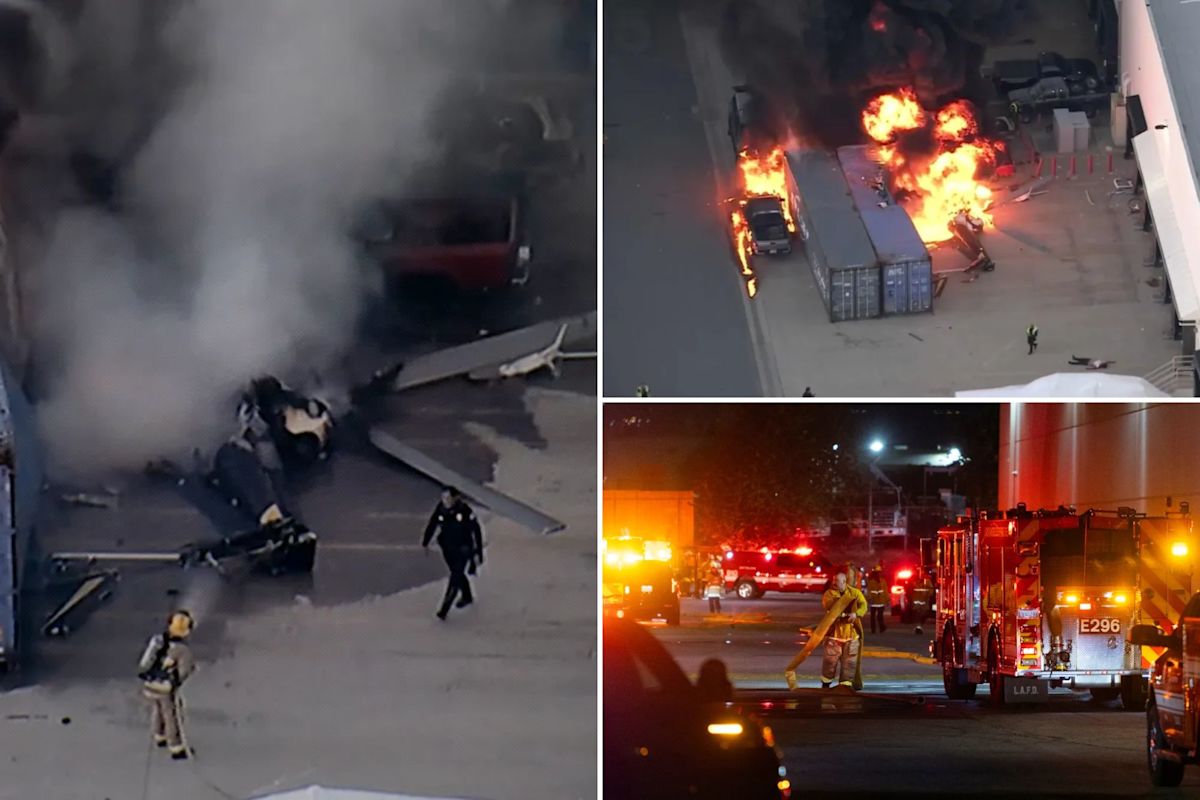
A catastrophic helicopter crash in the San Fernando Valley has prompted aviation observers to scrutinize the critical moments leading up to the disaster, with a prominent former aerial reporter offering a somber technical assessment. The incident, which took place in the Chatsworth neighborhood of Los Angeles, claimed multiple lives and prompted an immediate response from local and federal authorities.
According to details provided by the Los Angeles Fire Department, the aircraft went down in a confined space between two commercial structures, immediately bursting into flames upon ground contact. Emergency crews working near the vicinity of a bus crash rushed to the site, where three individuals were confirmed dead and one person was transported to a local hospital for urgent medical care.
In the aftermath of the deadly event, renowned helicopter pilot and veteran broadcast reporter Zoey Tur weighed in with an early evaluation based on an analysis of audio recorded prior to the impact. Tur, who spent decades pioneering airborne news gathering in Southern California, indicated that audio evidence pointed to severe mechanical distress before the aircraft crashed.
Examining the sound profile from the scene, Tur identified specific audible warnings that signaled critical trouble in the cockpit. The veteran pilot noted that the sound of the helicopter's low rotor revolutions-per-minute (RPM) annunciator horn could clearly be heard blaring, serving as an alert that the rotor blades were losing critical operational speed.
In addition to the warning horn, Tur observed that the helicopter's engine could be heard winding down, which points to a sudden loss of engine power while airborne. Such auditory cues, according to Tur, strongly suggest that the aircraft suffered an in-flight engine failure that left the crew in immediate peril over the urban landscape.
Tur further evaluated the pilot's emergency actions, noting that the audio indicated a delayed transition into autorotation by the pilot in command. Autorotation is the primary emergency aerodynamic procedure used by helicopter pilots to maintain rotor speed and execute a controlled landing when engine power is completely lost.
Following the review of the recorded audio, Tur posted a stark conclusion regarding the severity of the incident. Tur asserted that the combination of engine failure and the slow entry into an emergency autorotation glide created an unrecoverable scenario, leading to the devastating outcome with no survivors among those aboard the aircraft.
Tur is widely regarded as an authoritative voice in helicopter aviation and television news, having spent decades navigating the skies above the Los Angeles metropolitan region. Formerly known as Bob Tur, the aviator gained widespread recognition alongside former wife Marika Gerrard for capturing some of the most memorable live broadcast moments in modern media history.
Throughout an extensive career in aerial journalism, Tur's flight team established new benchmarks for breaking news coverage. Among these milestones was broadcasting the very first live airborne coverage of a high-speed police chase, a format that later became a regular fixture of television news across Southern California and the nation.
Tur's airborne camera was also responsible for documenting the violent 1992 assault on truck driver Reginald Denny during the Los Angeles riots. Two years later, in 1994, Tur famously tracked the slow-speed pursuit of O.J. Simpson's white Ford Bronco along Southern California freeways, delivering iconic live images to television audiences worldwide.
Over the course of a distinguished broadcasting career, Tur earned multiple Emmy Awards and Edward R. Murrow Awards in recognition of exceptional contributions to journalism and aerial reporting, establishing a deep professional familiarity with the operational realities of helicopter flight.
Following the Chatsworth crash, firefighters and emergency personnel worked to contain the fire and secure the scene between the commercial buildings. The intense blaze sparked upon impact created significant hazards, requiring rapid containment efforts from first responders on the ground.
Federal aviation authorities have initiated formal inquiries to uncover the definitive sequence of events that brought the helicopter down. The National Transportation Safety Board has taken the helm as the lead agency directing the investigation into the mechanical and operational components of the flight.
At the same time, the Federal Aviation Administration is actively engaged in reviewing administrative and operational facets related to the flight. The FAA's scope of inquiry is expected to encompass regulatory compliance, maintenance records, and pilot licensing standards.
Although experienced aviators have shared technical interpretations based on initial recordings, aviation officials emphasize that the formal investigation remains ongoing. Regulators have stated that the official cause of the fatal crash has not yet been determined as investigators continue to gather and analyze all available evidence.


(0)