
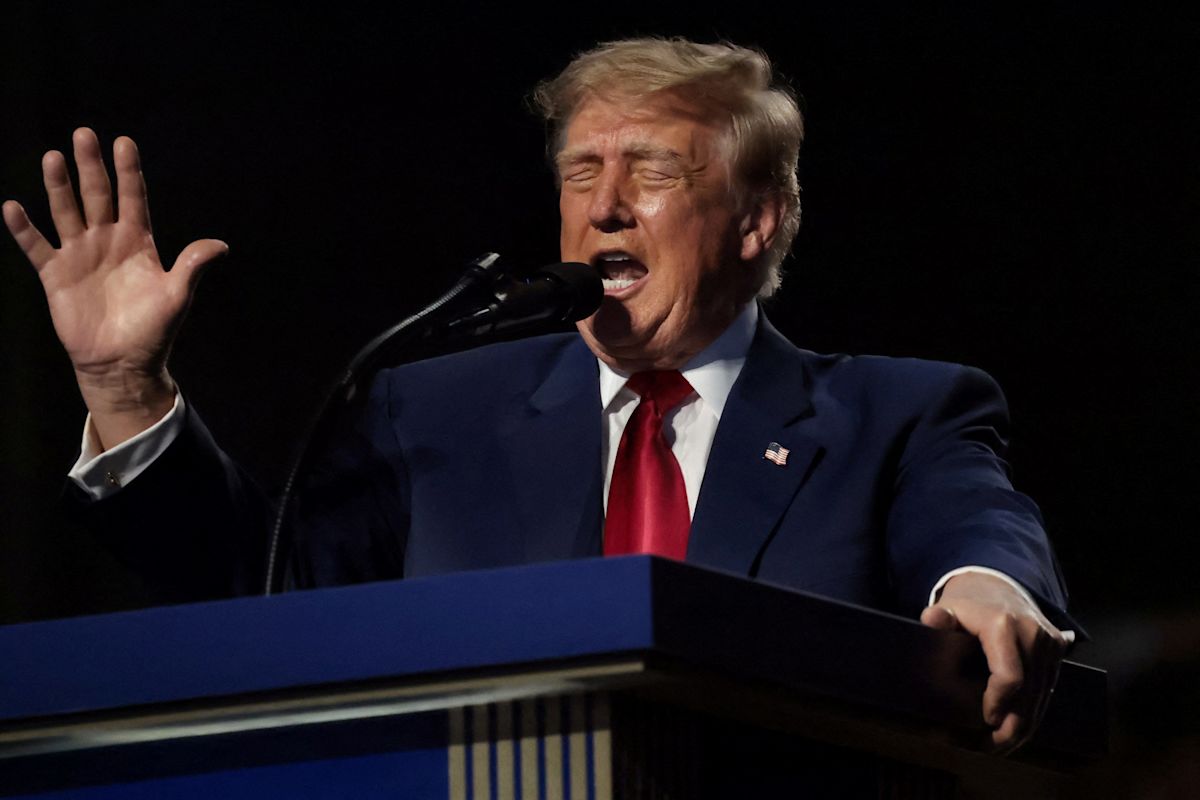
President Donald Trump has introduced a major campaign pledge ahead of the upcoming midterm elections, promising that every American adult will receive a $5,000 dividend check if the Republican Party wins control of both the House of Representatives and the Senate on November 3. The proposal, unveiled during a campaign rally in Dallas on September 9, presents a massive financial incentive to voters as both parties prepare to battle for congressional majorities.
Following the rally, the White House issued an official press release the next day detailing the conceptual framework for the proposed disbursements. According to the administration, the funding would be supported by general economic strength resulting from executive policies. The White House stated that the administration has successfully unleashed trillions of dollars in new private sector investments while simultaneously executing an aggressive and unprecedented effort to eliminate waste across the federal government.
Despite the administration’s optimistic outlook, policy analysts and fiscal watchdogs warn that implementing such a sweeping payout faces substantial practical and economic challenges. An analysis from budget experts, including the Committee for a Responsible Federal Budget, estimates that distributing $5,000 checks to every adult in the nation would carry a monumental price tag of approximately $1.2 trillion.
Economists caution that introducing an expenditure of this scale into the federal budget would carry heavy fiscal consequences. Injecting $1.2 trillion directly into the economy could substantially widen the national debt and potentially trigger fresh inflationary pressures, complicating broader macroeconomic stability at a time when budget deficits remain a central issue in Washington.
To put the scale of the proposed dividend into historical perspective, the Committee for a Responsible Federal Budget noted that the $1.2 trillion cost exceeds the combined expenditures of all three rounds of emergency stimulus checks issued during the COVID-19 pandemic. The total sum also surpasses the projected cost of the president's own signature legislative achievement, the "One Big Beautiful Bill" Act, scheduled for the upcoming year.
Furthermore, budget analysts pointed out that the $1.2 trillion payout would be roughly 50 percent larger than the total primary deficit projected for the federal government in 2027. Such immense costs mean that the plan would demand unprecedented budgetary maneuvers, even if Republicans were to secure control of both chambers of Congress in the fall elections.
Beyond the sheer cost, the mechanics of delivering direct cash disbursements to citizens present major procedural hurdles. A federal payout of this magnitude cannot simply be ordered through executive action alone; it requires formal authorization and appropriation from Congress. Securing legislative approval would likely take months of protracted debate and could face severe legal challenges in federal courts or before the Supreme Court.
This is not the first instance in which the president has tied major financial payouts to broad policy initiatives, only to encounter severe procedural and legal roadblocks. In early 2025, Trump floated the idea of a $5,000 stimulus payment that was intended to be funded by efficiency savings generated through the Elon Musk-led Department of Government Efficiency, widely known as DOGE.
However, the promised DOGE-funded stimulus checks never materialized for American households. The Department of Government Efficiency struggled to translate its cost-cutting initiatives into direct civilian payments and was subsequently shut down earlier this year, leaving the initial $5,000 check proposal unfulfilled.
A similar situation unfolded in November 2025, when Trump announced a plan to distribute $2,000 stimulus checks aimed at helping Americans cope with the rising economic pressures linked to his trade agenda. Under that framework, the administration intended to finance the direct payments through revenue collected from steep import tariffs imposed across all foreign trading partners.
That plan collapsed after facing decisive legal challenges. Once the Supreme Court issued a ruling declaring the administration's broad tariff policies unconstitutional, the primary revenue stream intended to support the $2,000 checks evaporated, rendering the prospect of those payments virtually impossible.
Despite these previous setbacks, the administration points to other targeted financial initiatives as proof that direct payments can be successfully executed. In December 2025, active military personnel received $1,776 bonuses designated as "Warrior Dividends." While Trump originally stated that those bonuses would be financed through tariff revenues, the funds were ultimately drawn from military housing appropriations previously established by Congress under the "One Big Beautiful Bill" statute.
The administration has also overseen the rollout of the "Trump Accounts" initiative, a program designed to provide long-term investment starters for young Americans. Under this program, the federal government deposits $1,000 into specialized savings accounts for children born between 2025 and 2028. As of July 6, the administration reported that approximately six million eligible children had accounts established on their behalf.
While smaller, targeted programs like the military bonuses and child savings accounts have moved forward, the newly proposed $5,000 adult dividend represents an undertaking of an entirely different magnitude. With the midterm elections scheduled for November 3, voters are left to weigh whether the president's latest $1.2 trillion pledge can realistically navigate the difficult fiscal, legislative, and judicial terrain that previously stalled similar proposals.


(0)