
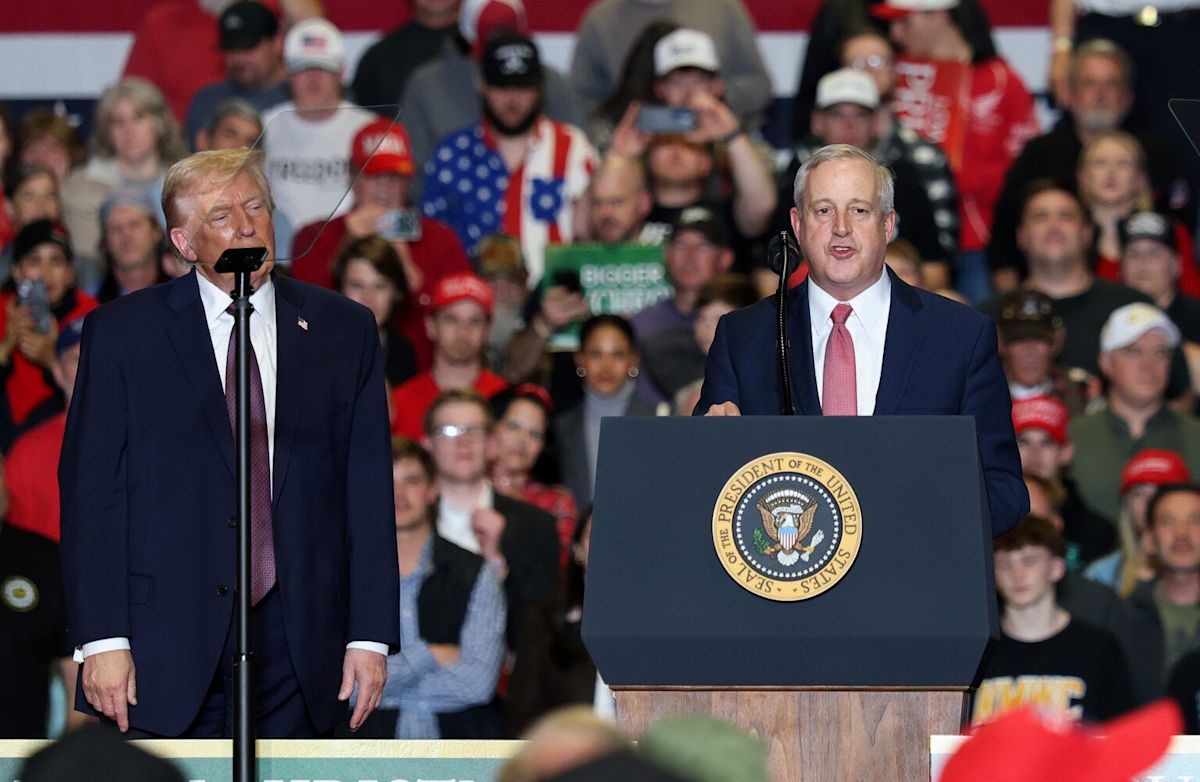
President Donald Trump is scheduled to travel to North Carolina on Wednesday to campaign alongside Republican U.S. Senate nominee Michael Whatley, a high-profile appearance that underscores mounting concerns within the national Republican Party regarding its standing in the crucial swing state.
The visit comes as Whatley faces an uphill battle to keep the seat in Republican hands following the retirement of GOP U.S. Sen. Thom Tillis. Recent polling and fundraising disclosures show Whatley consistently trailing his opponent, Democratic former Gov. Roy Cooper, in a contest that nonpartisan election handicapper Cook Political Report now rates as "lean Democrat."
The stakes for the open seat extend far beyond state borders, as the outcome could ultimately determine which party controls the upper chamber of Congress. Republicans presently hold a 53-seat majority, while Democrats control 45 seats alongside two independent senators who caucus with their party.
Whatley, who previously served as chairman of both the Republican National Committee and the North Carolina Republican Party, expressed strong enthusiasm about the upcoming appearance in his hometown of Gastonia. He framed the election as a vital opportunity to provide legislative backing for Trump's broader agenda, asserting online that Trump needs a loyal ally in the Senate while North Carolina requires an aggressive fighter, while predicting a GOP triumph come November.
Despite the fanfare surrounding the visit, political analysts suggest the event is designed for base mobilization rather than broad persuasion. Trump’s statewide approval rating currently lingers near 35%, making it unlikely that his presence will sway moderate or undecided swing voters toward Whatley's column.
According to Eric Heberlig, a political science professor at the University of North Carolina at Charlotte, the principal objective of the Gastonia rally is to energize dependable conservative voters and turn out low-propensity citizens who may be unacquainted with Whatley or unmotivated to participate in a midterm cycle. Heberlig noted that the path forward for the Republican nominee relies on consolidating the traditional party coalition that previously delivered victories for Trump as well as Republican Sens. Thom Tillis and Ted Budd.
The Republican ticket faces a formidable opponent in Cooper, who brings decades of statewide campaign experience to the contest. Cooper served four terms as North Carolina's attorney general—a 16-year tenure that stands as the longest in state history—before winning two consecutive terms as governor, giving him broad name recognition and an established political foundation that has proven durable in past elections.
While Democrats have experienced recent success in securing North Carolina's executive offices, breaking through in federal races has remained an enduring challenge for the party. North Carolina has not sent a Democrat to the U.S. Senate since 2008, the same year Barack Obama became the first Democratic presidential nominee to carry the state in 32 years, with all subsequent federal contests tilting toward Republicans.
Financial pressures are also shaping the battleground, as the state features some of the country's most expensive media markets, particularly in Charlotte and the Raleigh-Durham corridor. The steep cost of television and digital advertising could force both political parties to spend substantially more money than initially anticipated, potentially requiring national strategists to triage their financial commitments.
The spending calculations in North Carolina arrive amidst a demanding national map for Senate Republicans. In addition to defending the Tar Heel State, the GOP must protect competitive open seats in traditionally safe territory like Iowa and Texas, while defending incumbent lawmakers in Alaska, Maine, and Ohio. Simultaneously, the party is attempting to capture Democratic-held seats in battleground states including Michigan, New Hampshire, and Georgia.
Heberlig pointed out that the national arithmetic leaves Republicans with various avenues to preserve their Senate majority, even if North Carolina slips away. As party committees assess their nationwide investments, a central consideration is determining where funding can be most efficiently allocated to mitigate prospective net losses.
Trump's rally in western North Carolina could generate helpful downstream benefits for a beleaguered congressional race in the region. The state's 11th Congressional District was thrown into turmoil following the withdrawal of its incumbent, U.S. Rep. Chuck Edwards, amid controversy.
To replace Edwards on the ballot, the North Carolina Republican Party chose state Rep. Jennifer Balkcom. She is set to compete against Democratic nominee Jamie Ager, a fourth-generation farmer with deep political roots in the area, in a race that Cook Political Report classifies as "lean Republican."
Democratic leaders have seized upon Trump's visit as evidence of vulnerability within the GOP's midterm operation. North Carolina Democratic Party Chair Anderson Clayton characterized the event as a clear indicator of Republican unease, even as national party leaders recently sought to elevate Whatley's profile by granting him a prime speaking slot at the GOP's midterm convention in Dallas.


(0)