
Members of Rhode Island’s congressional delegation are intensifying pressure on the federal government, formally demanding answers and documentation from the Trump administration regarding the repeated denial of major disaster relief funds following a catastrophic winter storm in February 2026.
In a formal letter delivered on September 9, U.S. Senators Jack Reed and Sheldon Whitehouse, alongside U.S. Representatives Seth Magaziner and Gabe Amo, called upon the Department of Homeland Security and the Federal Emergency Management Agency to preserve and turn over all records connected to the state's rejected disaster declaration requests.
The congressional inquiry centers on Rhode Island’s unsuccessful bid to secure federal relief funding to help cover millions of dollars in municipal and statewide recovery expenses generated by the hurricane-force blizzard, which dumped unprecedented amounts of snow across the region.
Federal oversight of emergency management falls under the jurisdiction of the Department of Homeland Security, which directs FEMA's operations and handles formal declarations of major disasters across the United States.
Lawmakers expressed strong frustration over the lack of transparency from federal administrators, pointing out that Rhode Island officials have yet to receive any comprehensive written rationale explaining why their disaster relief application was turned down despite meeting and surpassing established financial criteria.
The state’s formal push for federal assistance began on April 7, when Rhode Island Governor Dan McKee submitted an initial application seeking $19 million under the provisions of the Stafford Disaster Relief and Emergency Assistance Act.
The Stafford Act serves as the primary federal mechanism enabling state governors to petition Washington for emergency resources when severe weather strikes or when an incident's scope surpasses the administrative and fiscal capabilities of state authorities.
FEMA formally rejected Rhode Island’s initial relief application on July 2. Governor McKee promptly appealed the federal agency's determination, only for FEMA to issue a second, definitive rejection on September 2.
The repeated refusals prompted sharp criticism from state leadership, with Governor McKee describing FEMA’s refusal to assist Rhode Island communities with their storm recovery as a new low in federal-state relations.
Throughout both stages of the process, federal emergency officials declined to provide granular justifications for their rulings, relying instead on boilerplate language in their official correspondence asserting that supplemental federal assistance under the Stafford Act was not warranted after evaluating available information.
Public comments from federal leadership further inflamed the dispute when FEMA Administrator Cameron Hamilton took to the social media platform X on September 3 to defend the decisions, which also affected disaster relief petitions filed by neighboring states including New York, New Jersey, and Massachusetts.
In his online remarks, Hamilton asserted that none of the affected northeastern states had presented new evidence to justify reconsidering the denials, adding dismissively that winter weather is not a novel phenomenon for the Northeast region.
Rhode Island’s federal delegation vigorously rejected Hamilton's characterization, arguing that the February 2026 weather event went far beyond standard seasonal snowfall and caused damage that crippled local infrastructure.
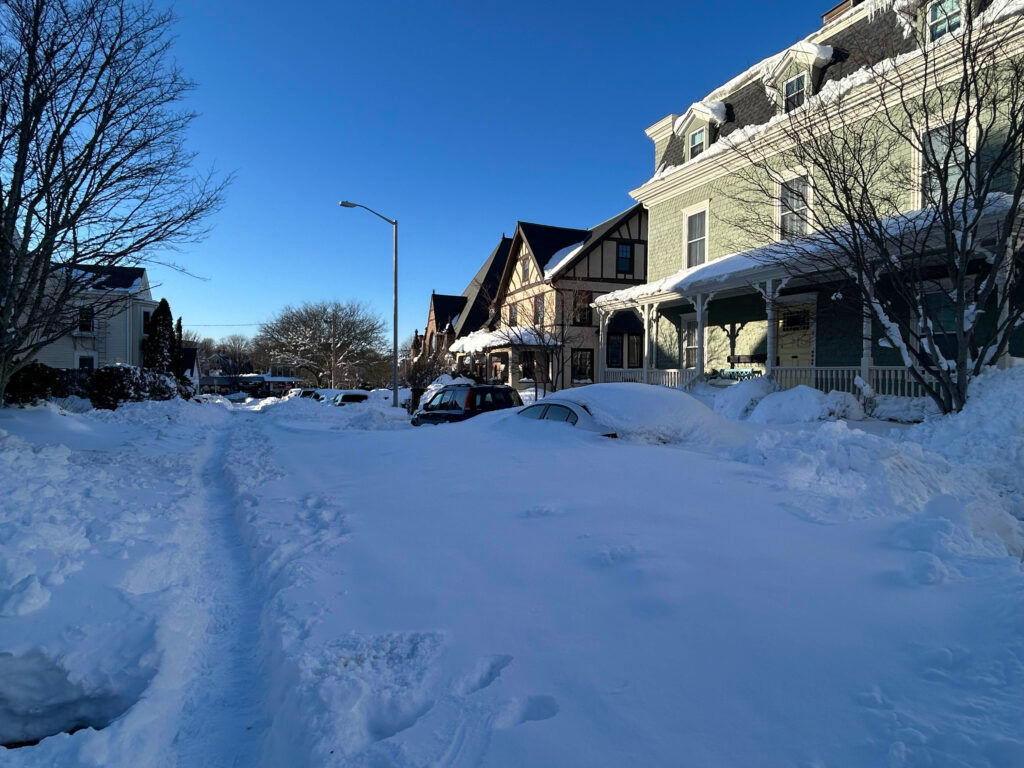
Meteorological data from the storm underscores its historic scale. When the blizzard struck on Monday, February 23, Rhode Island T.F. Green International Airport measured 37.9 inches of snowfall, eclipsing the previous benchmark of 28.6 inches set during the notorious Blizzard of 1978.
Beyond record snow accumulation of more than 3 feet in multiple communities, the system generated destructive wind gusts reaching 74 mph, carrying the intensity and physical magnitude of a Category 2 hurricane while knocking out electricity to thousands of households statewide.
The financial burden of the storm reached approximately $19 million, encompassing roughly $9 million incurred directly by state agencies alongside another $10 million absorbed by local cities and towns for emergency response, equipment, and extensive cleanup operations.
In their communication, the Rhode Island lawmakers stressed that trivializing the multi-million-dollar disaster as ordinary winter weather diminishes the significant hardships endured by residents and businesses whose livelihoods were disrupted.
The delegation maintained that disclosing all interagency communications and assessment records is essential to verify how FEMA reached its conclusions and whether Administrator Hamilton’s public assertions are genuinely backed by internal agency documentation.
Lawmakers warned that should federal authorities fail to preserve and deliver the requested files, observers can only reasonably conclude that FEMA's justification for denying the state's blizzard aid is entirely without merit.
When approached for comment on the congressional inquiry, representatives from both FEMA and the Department of Homeland Security maintained the administration's official position, reiterating that the states requesting disaster funds had failed to submit new information to substantiate their claims.




(0)