
Renton is set to consider a sweeping municipal ordinance that would prohibit unauthorized camping on public property throughout the city. The Renton City Council has scheduled a formal vote on the measure for Monday, positioning the municipality to follow a growing list of Western Washington communities seeking to regulate public encampments through local legal frameworks.
The legislative push comes in the wake of a pivotal United States Supreme Court decision concerning municipal authority over public spaces. The high court ruled that local bans on public camping do not violate the Eighth Amendment's prohibition against cruel and unusual punishment, clearing a significant constitutional hurdle for cities seeking to enforce stricter rules regarding public spaces.
That federal ruling has already triggered similar policy changes across several nearby jurisdictions. Municipalities such as Lakewood, Tukwila, and Burien have already implemented local camping bans, establishing a regional precedent that Renton council members are now considering adopting within their own city limits.
Under the terms of Renton's proposed ordinance, individuals would be strictly prohibited from setting up temporary living structures on public land. The restrictions explicitly ban the erection of tents and tarps across all city-owned property, including public parks, municipal trails, and civic parking areas.
The draft legislation also targets activities frequently associated with long-term encampments. If approved, the ordinance would outlaw the lighting of open fires on city property, the long-term storage of unattended personal belongings, and the unauthorized stashing of shopping carts within public spaces.
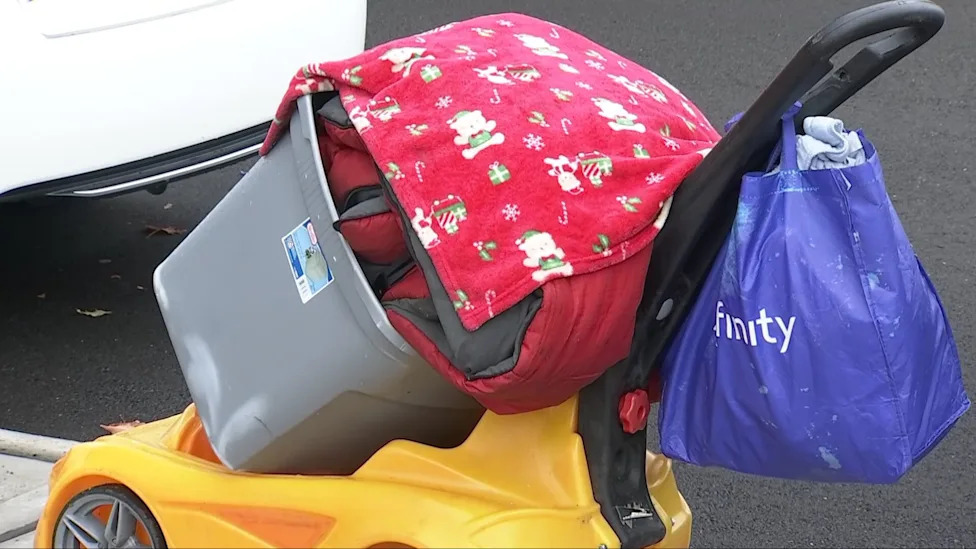
For unhoused individuals living in the area, the potential policy change brings acute uncertainty. Nicole, a local resident who has experienced homelessness for roughly three to four years after losing everything she owned, spends her days traversing downtown Renton with all her worldly possessions packed onto a child's push car.
Nicole, who typically relies on public parking lots as places to sleep at night, expressed deep apprehension regarding the prospect of being forced off municipal property. For her and others in similar circumstances, city-owned parking areas have served as primary resting spots away from residential foot traffic.
When asked about utilizing traditional municipal or charitable shelter systems as an alternative to sleeping outdoors, Nicole voiced strong resistance. She explained that she harbors deep skepticism toward group shelter facilities, describing them as environments that she considers unhealthy, untrustworthy, and fundamentally unsafe compared to remaining on the street.
This reluctance to access existing shelter networks highlights a central dilemma embedded in the enforcement of public camping restrictions. With outdoor encampments banned and personal reservations keeping individuals away from indoor shelters, unhoused residents face increasingly narrow options for where they can legally exist.
To address these challenges, the proposed ordinance stipulates that city personnel and outreach teams must first attempt to connect unhoused individuals with social services and available community resources before pursuing punitive measures. The inclusion of outreach mandates aims to ensure that aid is formally presented as an initial step.
However, the ordinance also incorporates structured enforcement mechanisms for non-compliance, including the establishment of formal trespassing zones. These geographic boundaries would allow authorities to legally bar individuals from returning to specific city properties once they have been instructed to vacate the premises.
For individuals who repeatedly refuse to comply with the encampment restrictions, the measure introduces legal penalties. Repeat violators could face formal misdemeanor charges, which under existing state and local law carry potential penalties of up to 90 days in jail alongside fines reaching as high as $1,000.
Proponents of the measure maintain that regulatory enforcement is essential for preserving public order while simultaneously guiding vulnerable people toward necessary support. Max Komar, a representative from the non-profit organization Battlefield Addiction, which works directly with individuals struggling with substance abuse in local encampments, emphasized that community compassion must be balanced with personal accountability.
Komar noted that while individuals living in camps require dedicated outreach, neighboring residents and families also have a fundamental right to safe, clean public environments. He voiced support for reasonable municipal policies designed to curtail open-air drug activity and dismantle unsanctioned encampments, provided those policies actively link individuals to specialized treatment and support programs.
As the Renton City Council prepares to cast its vote, the decision reflects a critical juncture for municipal governance, balancing the complex needs of vulnerable unhoused populations with broader community demands for public safety and accessible public lands.


(0)