
A large-scale maritime search and rescue operation was launched in Indonesia on Sunday after an inter-island passenger ferry overturned in turbulent waters across the Java Sea. The disaster has left approximately 130 passengers and crew members unaccounted for, prompting emergency responders to deploy extensive naval and aerial resources in a race against time to locate survivors.
Maritime authorities reported that at least 107 individuals have been pulled alive from the water, while the remains of six passengers have been retrieved. The coordinated search efforts have steadily expanded across the waters surrounding the vessel's last reported coordinates, where teams continue to scour the area for any sign of those still missing.
The stricken ship, identified as the Virgo Transport 8, was transporting well over 240 people alongside dozens of vehicles when calamity struck. The vessel had departed from the port city of Surabaya in East Java and was charting a course north toward Banjarmasin, located in the South Kalimantan province on the island of Borneo.
Severe meteorological conditions in the Java Sea are believed to have played a decisive role in the capsizing. Prior to the vessel losing communication, the captain reported battling heavy swell and rough sea conditions, with waves towering up to 10 feet. Recognizing the escalating peril as the ferry began to list dangerously to one side, the crew transmitted an urgent distress message.
I Putu Sudayana, the head of the Banjarmasin Search and Rescue Office, stated that emergency authorities later received confirmation that the ship had completely rolled over in the violent waters. The agency in Banjarmasin was formally alerted to the crisis approximately two hours after all radio and tracking contact with the ferry ceased at around 2:00 a.m. on Sunday.
Search teams were promptly dispatched to the vessel's last recorded position in the open waters of the Java Sea, roughly 92 miles from its intended destination at Banjarmasin. Aerial reconnaissance conducted shortly after the incident provided key insights into the condition of the craft, revealing that the ferry had not plunged to the ocean floor.
Indonesian Transportation Minister Dudy Purwagandhi confirmed to reporters that aerial surveillance flights spotted the vessel floating completely upside down. With the hull remaining buoyant on the surface, emergency crews have focused their primary rescue operations and perimeter searches directly around the inverted wreckage to check for trapped or drifting survivors.
The search mission has escalated into a multi-agency mobilization. By Sunday afternoon, disaster response commanders had deployed specialized teams supported by a fleet of eight vessels—including four Indonesian Navy warships—alongside two helicopters conducting low-altitude sweeps across the surrounding sea sector.
According to official administrative records, the ship’s manifest documented 243 individuals on board at the time of departure, comprising 213 passengers and 30 crew members. The ferry was also laden with a substantial cargo of 89 vehicles stowed within its decks.
However, maritime officials acknowledge that exact numbers remain uncertain, as it is a frequent occurrence in Indonesian inter-island transport for the actual number of travelers aboard to diverge significantly from the figures logged on paper manifests. The presence of unmanifested passengers often complicates accountability assessments and victim identification in the wake of sea accidents.
The unfolding crisis prompted hundreds of distraught relatives to converge at Trisakti Port in Banjarmasin, where an emergency coordination center was established to handle inquiries and coordinate support. Family members waited anxiously through the day, crowding notice boards to inspect evolving survivor registries and manifest logs.
Among those waiting at the port was a woman identified by the single name Bunga, who described the harrowing experience of discovering a family member was aboard the ill-fated ship. She recounted her initial shock upon finding her uncle's name recorded on the manifest, which turned to overwhelming relief once port officials confirmed he had been safely rescued.
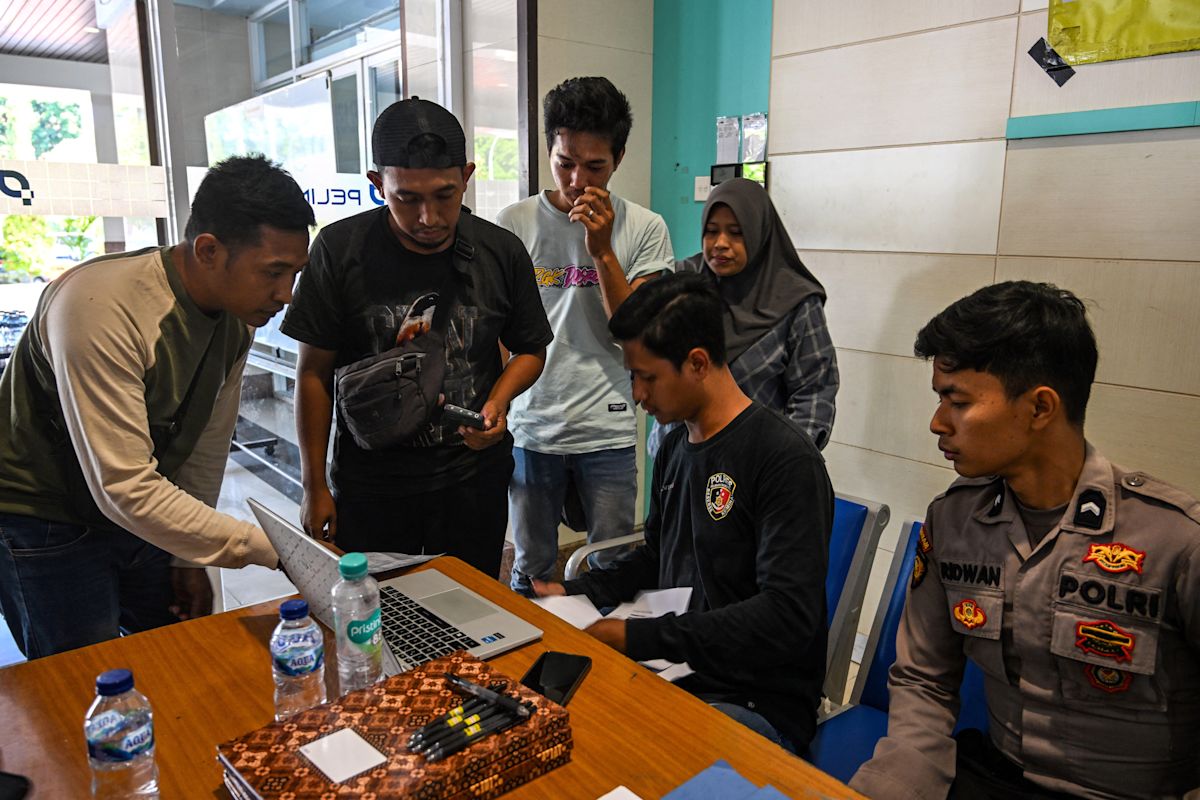
Other family members endured agonizing uncertainty as authorities processed information. Police officers and port staff were seen interviewing anxious relatives, including Ela Nur Atika, whose husband was traveling aboard the vessel, as emergency personnel worked to cross-reference passenger identities with those recovered from the sea.
The incident underscores the persistent dangers associated with water transport across the Indonesian archipelago, a vast nation encompassing more than 17,000 islands. Ferries serve as an indispensable mode of transit connecting remote provinces and major economic hubs, yet the maritime network is frequently plagued by catastrophic accidents often attributed to challenging weather patterns, overloading, and relaxed enforcement of safety regulations.


(0)