
In an ambitious effort to shield working-class residents from the strain of grocery inflation, Newark officials and community leaders have launched a network of five nonprofit, municipally subsidized food markets across the city. Designed to lower the financial burden on local households, the newly opened storefronts rely on public seed money and strict price caps to offer everyday food staples and household essentials at substantially reduced rates compared to traditional commercial supermarkets.
The initiative was formally introduced during a gathering of roughly one hundred community members, civic leaders, and nonprofit representatives at one of the newly converted storefronts. To highlight the immediate impact on household budgets, organizers presented direct price comparisons on staple consumer goods. Peter Rosario, the executive director of the Latino-focused social services organization Casa De Don Pedro, displayed a 9.6-ounce container of Folger's coffee, noting that while traditional commercial grocers often charge $8.99 for the item, the subsidized market offers it to local shoppers for $7.49.
Following that presentation, Vesta Godwin Clark, executive director of the St. James Social Service Corporation, demonstrated further price disparities with everyday pantry items. Holding up a jar of pickles, Clark pointed out that the item typically retails for $3.79 at commercial chains like ShopRite, whereas it is sold for just $3.00 at the newly opened community market. Organizers emphasized that such incremental savings across weekly shopping trips can provide meaningful relief to families navigating tight household budgets.
The public grocery network is part of a broader push by Newark Mayor Ras J. Baraka to maintain living affordability within New Jersey’s largest city as it experiences ongoing economic development. Speaking at the formal unveiling at the New Street location, Baraka stressed that access to reasonably priced nutrition is an essential standard that should be guaranteed to every resident. He emphasized that no community member should be left wondering whether their household can afford an adequate supply of food.
To establish the program, municipal authorities distributed $250,000 grants to each of the five participating nonprofit organizations following a comprehensive review of their qualifications. According to Rosario, whose organization established a grocery location at Casa de Don Pedro's Broadway complex, the grant allocations function as flexible start-up capital. Participating nonprofits are permitted to apply the funds toward structural build-outs, equipment, initial inventory purchases, employee compensation, and general operational expenses.
Under the regulatory framework governing the initiative, the nonprofit storefronts must adhere to strict pricing limitations. Specifically, operators are barred from applying a markup exceeding 30% above the wholesale cost of goods. By limiting profit margins and eliminating the overhead demands typical of corporate retailers, the markets are structured to pass maximum savings directly along to local consumers.
The roots of the initiative trace back to an acute local food crisis in November, when a federal government shutdown disrupted the timely distribution of Supplemental Nutrition Assistance Program (SNAP) benefits. In response to the funding delays, Baraka convened local nonprofit leaders to establish emergency food relief centers throughout all five municipal wards. The success of those temporary hubs served as the operational blueprint for establishing permanent, low-cost grocery alternatives.
City officials confirmed that expanding assistance access remains central to the grocery network's operational mission. All five subsidized locations are actively preparing to accept both standard SNAP electronic benefit transfers and Special Supplemental Nutrition Program for Women, Infants, and Children (WIC) benefits. This integration ensures that low-income families, mothers, and young children can directly utilize their federal nutritional support within the discount storefronts.
Explaining the partner selection process, city spokesperson Crystal Rosa stated that the participating organizations were chosen due to their established presence within their designated wards. The city prioritized groups with extensive histories in community food security, including previous operations of soup kitchens, food pantries, and farmers markets, as well as a documented record of supporting municipal food distribution programs.
The physical transformations of the grocery sites reflect adaptive community revitalization. For example, the Central Ward store, named "Our Community Grocery Store" and operated by the St. James Social Service Corporation, is housed in a low-rise brick structure that originally operated as an automotive repair garage. The exterior of the building on New Street now features a vibrant, produce-themed mural displaying the words "Care," "Fresh," and "Hope" within an otherwise residential neighborhood.
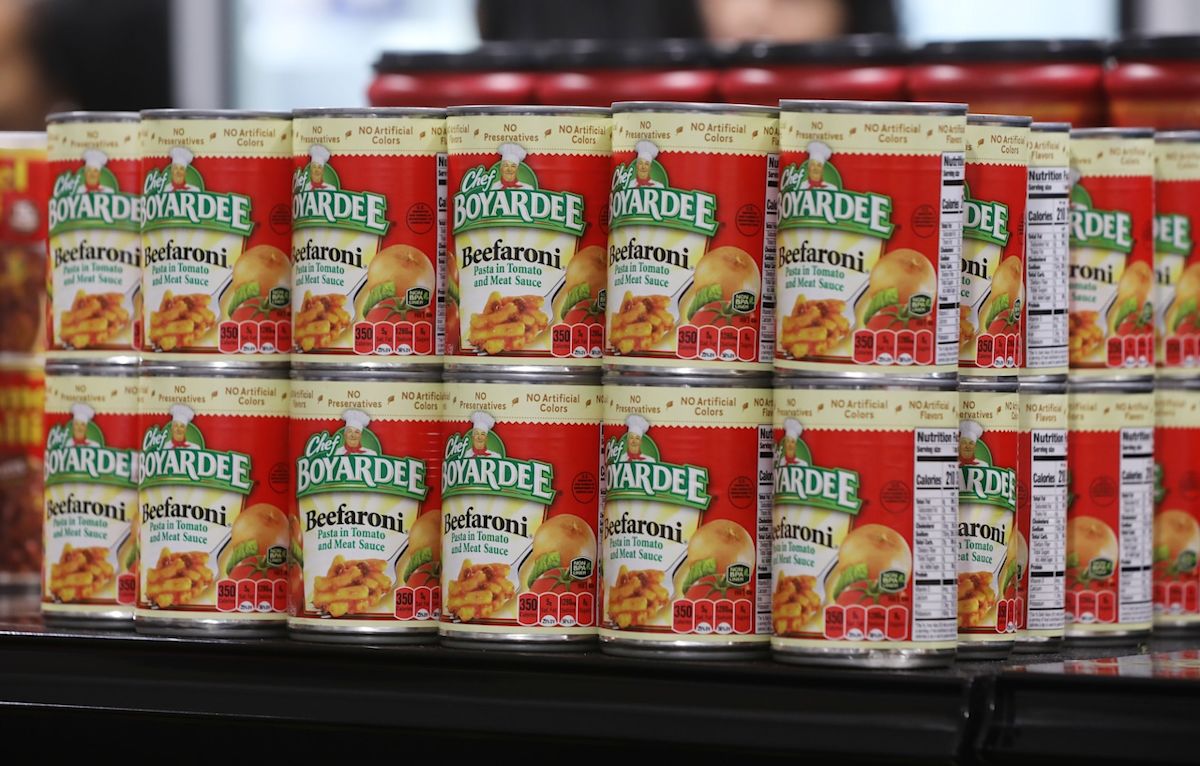
Inside the converted New Street facility, the retail space is fully stocked with a wide range of familiar grocery brands and pantry goods. Shelves feature items such as pasta sauce, macaroni and cheese, canned tuna, black beans, chili, oats, corn chips, breakfast cereals, pancake mix, and syrup. In addition to shelf-stable goods, temperature-controlled refrigerated cases provide fresh perishables including broccoli, chicken thighs, and bacon, alongside essential personal hygiene and household products such as soap, toothpaste, and toilet paper.
The five locations are strategically distributed to ensure geographical equity across Newark's five wards. In addition to the St. James Social Service Corporation location at 312 New St. in the Central Ward and the Casa de Don Pedro site at 39 Broadway Ave. in the North Ward, the network includes Mantena Global Care at 296 Ferry St. in the East Ward, the Clinton Hill Community Corporation at 393 Hawthorne Ave. in the South Ward, and the United Community Corporation at 503 Central Ave. in the West Ward.
While Newark does not directly own or manage the daily operations of the groceries, the municipal government maintains regulatory oversight. City monitoring is conducted through the Office of Sustainability, Resilience and Community Transformation to ensure that operators continue to fulfill grant requirements and comply with the mandatory pricing caps.
Newark's model stands in contrast to a municipal grocery initiative proposed in neighboring New York City by Mayor Zohran Mamdani. While the New York concept envisions city-owned storefronts managed by private contractors mandated to price items 30% below retail, Newark opted for independent nonprofit ownership subsidized by municipal grants. Furthermore, while the New York City plan prompted a lawsuit from the Multicultural Business Coalition alleging unfair commercial competition, Baraka noted that Newark has not encountered pushback from regional business organizations. Outlets representing the retail industry, including the New Jersey Food Council and the Newark Area Business Partnership, did not provide comment on the program.


(0)