
Sweeping legislation introduced in Trenton aims to dramatically curtail the use of artificial intelligence-powered automated license plate readers across New Jersey. The proposal seeks to eliminate private surveillance networks while establishing rigorous operating restrictions for law enforcement and government agencies, including a mandate requiring the deletion of most captured vehicle data within two days.
Assembly Bill A5483, introduced on September 14 by Assemblyman David Bailey Jr., a Democrat representing Salem County, is designed to regulate automated license plate recognition technology, widely known by the prominent brand name Flock Safety. These systems rely on roadside cameras equipped with artificial intelligence to log passing vehicles by recording license plate numbers, exterior colors, makes, and models into searchable tracking databases.
Under the provisions of the proposed measure, private citizens, commercial establishments, and non-governmental entities would be barred entirely from owning, installing, or operating automated plate readers. The only exception would apply to authorized commercial vendors hired specifically to supply or install the hardware for legally permitted government entities.
To enforce the comprehensive ban on private surveillance hardware, the bill requires all private owners to immediately dismantle their existing camera systems and permanently delete any historical logs they have retained. The legislation gives the New Jersey Attorney General full statutory power to initiate legal proceedings against any non-compliant businesses or individuals.
For public sector entities, the legislation substantially limits the permissible scope of camera operations compared to current practices. Civilian state and municipal agencies would be permitted to deploy the scanning devices solely for designated administrative tasks, such as overseeing public parking facilities, securing restricted government access points, and processing automated electronic toll transactions.
Under the bill, the New Jersey State Police and local municipal police departments would see their authority strictly tied to designated "be on the lookout," or BOLO, notifications. Permissible law enforcement applications would be restricted to tracking stolen automobiles, locating missing individuals, investigating serious crimes, or identifying vehicles with expired registrations, lack of insurance, or state inspection infractions.
The legislation also integrates explicit civil rights safeguards into police surveillance practices. Law enforcement agencies would be legally prohibited from deploying camera networks to target specific neighborhoods or motorists based on race, religious beliefs, national origin, disability status, or other protected characteristics.
The bill’s most significant policy change focuses on data retention schedules. Currently, New Jersey allows government agencies to store captured license plate data for three years, representing one of the longest retention windows in the nation. By contrast, most states discard non-investigative plate scans within 30 days or less, and select jurisdictions wipe non-matching records in as little as five minutes.
Bailey’s proposal would replace New Jersey’s three-year timeline with a strict rule requiring the automatic and permanent deletion of scanned records within two days. Exceptions to this 48-hour purge requirement would be granted only for scans connected to active criminal investigations, valid court orders, or vehicles formally flagged for serious offenses, lack of registration, or theft.
The legislation would also reshape how vehicle tracking records are shared across state and federal boundaries. Under current practices, the State Police permit selected neighboring state agencies and New Jersey-based federal law enforcement partners to access the state’s repository, but the new bill would require an Attorney General-approved judicial warrant prior to releasing any data to external agencies.
Furthermore, private equipment manufacturers and vendors would be prohibited from selling, commercializing, or distributing driver information collected by their systems. To maintain accountability across public entities, government agencies operating camera systems would be subjected to mandatory annual audits alongside regular public reporting obligations.
The introduction of the measure comes amid an unprecedented expansion of automated surveillance technology throughout the state. According to New Jersey's most recent annual audit, 523 of the approximately 530 police agencies operating statewide utilize automated license plate readers, with at least 82 departments across all 21 counties contracting specifically with Flock Safety.
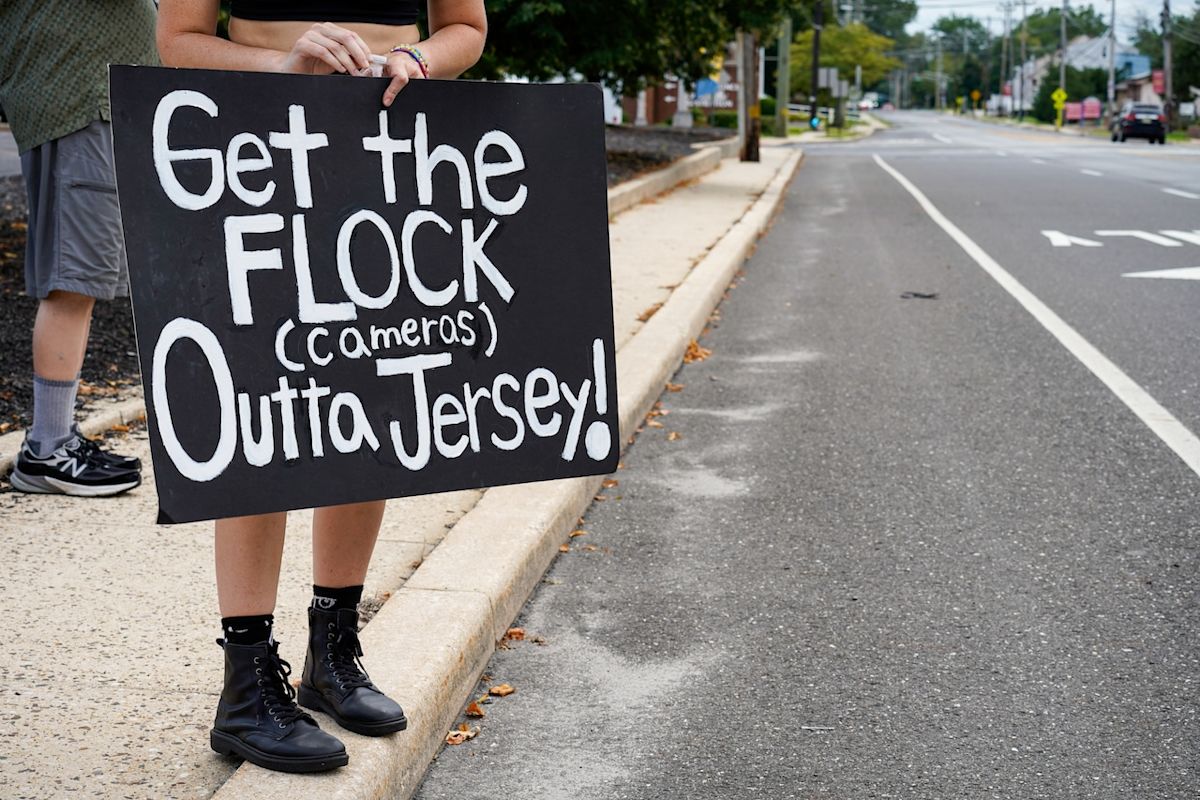
The pervasive growth of these camera networks has sparked growing pushback from privacy advocates and community members. In August, more than 25 demonstrators organized by the advocacy coalition DeFlock South Jersey gathered outside a Berlin Township retail store, accompanied by an activist in a bird mascot costume named "Flocky," to demand an immediate halt to mass camera surveillance until stricter laws are passed.
Community resistance has also surfaced at municipal government meetings across the region. In Franklin Township, a crowded council session over local camera deployment drew substantial public criticism, supported by a petition signed by more than 800 residents seeking to rein in unrestricted surveillance.
Assemblyman Bailey is not the only state lawmaker seeking to impose boundaries on camera networks in Trenton. State Senator Benjie Wimberly, a Democrat from Passaic County, previously introduced stalled legislation to lower the data retention limit to two years and establish criminal penalties for misuse, while Democratic Senator Linda Greenstein of Middlesex County has proposed barring data sharing for out-of-state abortion investigations, and Republican Senator Michael Testa of Cumberland County has prepared his own guardrail bill.
Bailey has emphasized that the primary goal of the legislation is to protect civilian privacy rights without hindering legitimate law enforcement efforts. The lawmaker stressed that while plate readers offer useful crime-fighting utility, unrestricted surveillance of innocent motorists must be reined in through strict statutory boundaries, independent state oversight, and balanced regulation.


(0)