
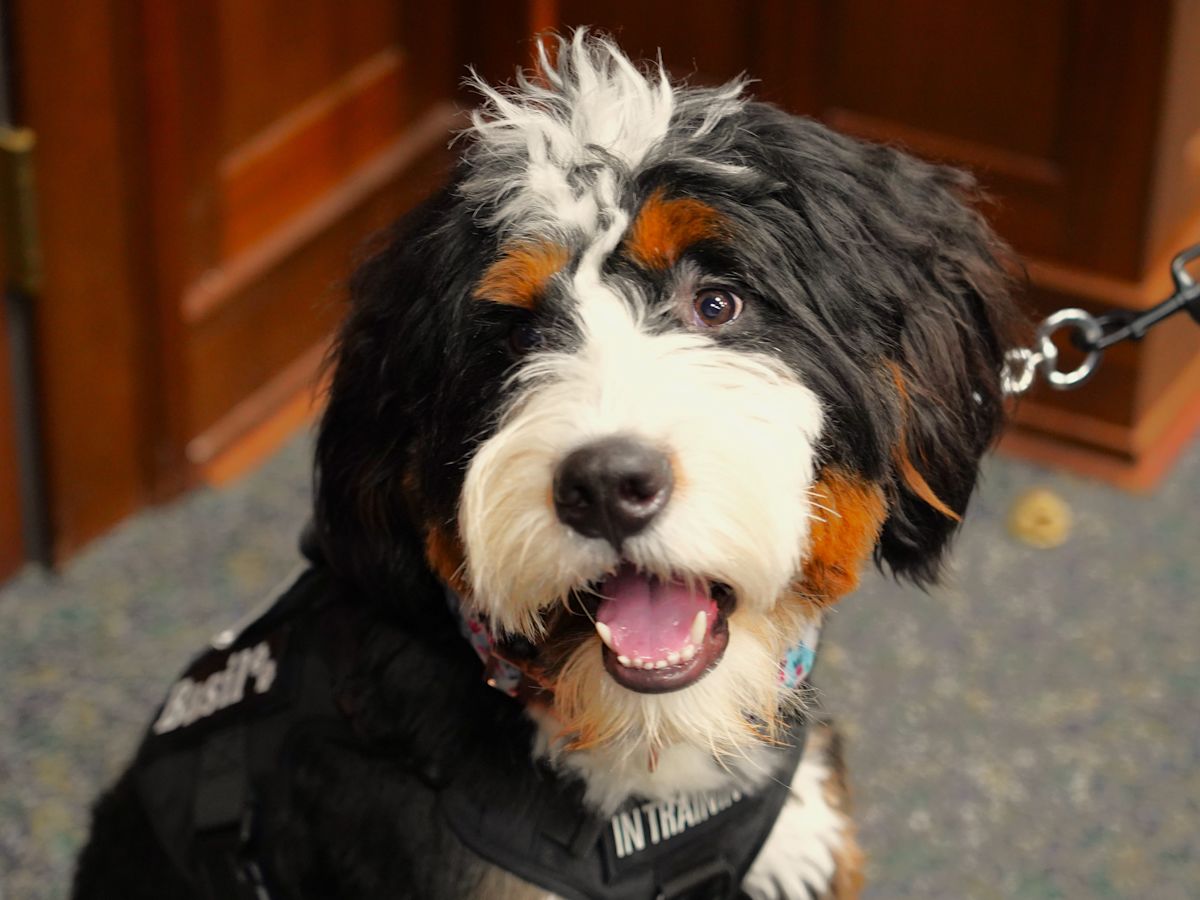
For many residents, finding a jury summons in the mailbox is an unwelcome surprise that brings thoughts of disrupted schedules and tedious waiting. In Hamilton County, Ohio, however, individuals selected for grand jury duty are greeted by an unexpected and comforting colleague: a therapy dog named Basil.
Basil serves as the official therapy dog for the Hamilton County Prosecutor's Office. Instantly recognizable by the mop of white fur framing his cheerful face and the small vest displaying his name, the canine can often be seen walking through office corridors alongside prosecutors and detectives. His primary role is providing emotional support to crime victims and their loved ones, as well as offering comfort to grand jurors who must absorb distressing evidence in traumatic criminal cases.
Grand juries operate far differently from the dramatic trial juries commonly portrayed in television shows and movies. Rather than deliberating inside formal courtrooms to decide whether a defendant is guilty or innocent, grand jurors meet in standard conference rooms to evaluate whether there is sufficient evidence to bring formal criminal charges. Panelists are drawn from local voter registration records and driver's license databases, reporting for duty on a regular schedule.
The assignment also offers practical conveniences that differ from standard trial jury service. During their typical two-week term, grand jurors report to a separate facility and are able to avoid the lengthy security screening lines that frequently bottleneck visitors entering the main county courthouse.
The grand jury mechanism is utilized by roughly half of all U.S. states to determine if prosecutors have enough evidence to proceed with criminal indictments. Across these jurisdictions, the process serves as a critical preliminary check within the criminal justice system before a case ever advances toward a potential trial.
In Ohio, the scope of grand juries is specifically reserved for serious felony offenses rather than minor infractions. In Hamilton County, panels are tasked with evaluating all felony allegations as well as any misdemeanor offenses directly connected to a felony charge.
The structure of grand jury hearings is unique because the accused individual and their defense attorney do not attend or present arguments. Instead, the proceeding is one-sided, though grand jurors retain the authority to actively question police officers, investigators, and other witnesses who appear to present evidence.
According to guidelines from the Ohio Judicial Council, the primary duty of the grand jury is to determine whether the presented evidence is sufficiently credible and reliable to conclude that the accused person probably committed the crime. The threshold of "probably" forms the legal foundation for establishing probable cause.
In Hamilton County, each grand jury panel consists of nine members. For a case to move forward to an indictment, at least seven of the nine jurors must vote in favor. If the threshold is not met, the case is dismissed through what court officials refer to as a "no bill" or an "ignored" case, though prosecutors may bring the matter back before a grand jury if new evidence is later discovered.
The proceedings take place inside the Hamilton County Prosecutor's Office building on Ninth Street, located just one block from the courthouse. The two grand jury rooms are somewhat cramped and lack the high ceilings of standard courtrooms. Over decades of near-constant use, the wood-paneled walls have developed deep scuffs and wear marks from the backs of jurors' chairs repeatedly rubbing against them.
Efforts have been made recently to improve the functionality and comfort of these workspaces. Kate Burroughs, who has served as the Chief of Grand Juries and Intake since January 2025, enlisted the volunteer help of her daughters to clean and revitalize the rooms. Their updates included patching well-worn chairs, adding tables where none previously existed, and installing a modern television monitor. Prior to the monitor's installation, detectives routinely had to circulate around the room displaying photos and video evidence directly from their smartphones.
The operational tempo inside the facility is continuous. Hamilton County Prosecutor Connie Pillich noted that grand juries convene Monday through Friday, 52 weeks a year, pausing only for select holidays.
While smaller Ohio counties convene grand juries infrequently due to lower population numbers, Hamilton County's heavy caseload requires two separate panels of nine jurors, along with alternates, working every single weekday.
The volume of matters processed through this system is substantial. Pillich reported that local grand juries reviewed more than 5,700 cases throughout 2025 alone. Over the course of a standard two-week assignment, an individual juror may hear evidence in 100 cases or more.
To prepare citizens for this fast-moving environment, the first day of service begins with an orientation covering essential legal definitions. Burroughs explained that jurors receive instruction on concepts such as acting "knowingly" or "recklessly," the legal definition of "possession," and the current firearm laws in Ohio. To help them find their footing, jurors are assigned a lighter docket on their first day before taking on larger and more complex cases.
Pillich emphasized that the proceedings are focused strictly on the facts rather than courtroom theatrics. The largest portion of the cases reviewed by the panels involves drug possession and drug trafficking offenses, keeping jurors and Basil steadily engaged throughout the year.


(0)