
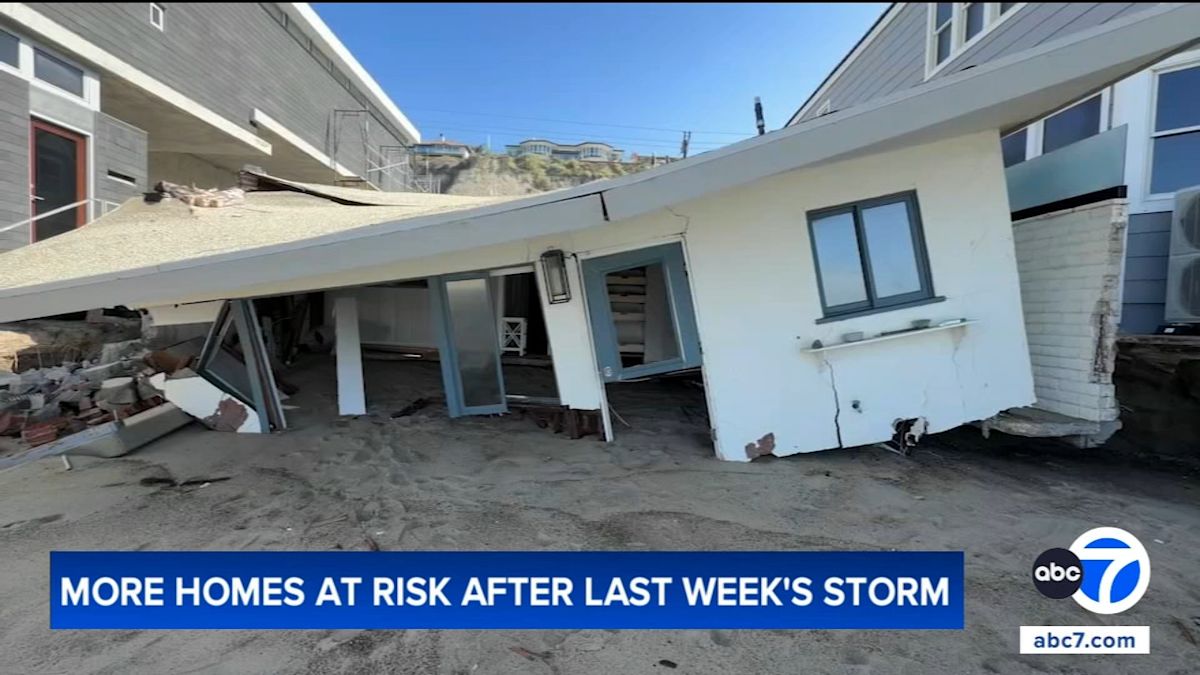
In the wake of severe coastal turbulence stirred up by Hurricane Marie, Capistrano Beach is facing an escalating residential crisis as powerful ocean waves continue to erode the shoreline and compromise waterfront structures. Following last week’s intense storms, another property succumbed to the relentless surf and began sinking directly into the Pacific Ocean, prompting municipal building officials to declare ten additional homes uninhabitable. The ongoing destruction has intensified fears among local property owners who warn that entire stretches of their coastal community are slipping into the sea.
In response to the growing devastation along Beach Road, the City of Dana Point has officially issued a local emergency declaration. Municipal safety assessments have resulted in ten residences being red-tagged, signaling that the buildings are completely unsafe to occupy, while an additional seven structures have received yellow tags denoting restricted and hazardous access. The designations reflect severe structural instability beneath foundation lines caused by rapid shoreline erosion and relentless wave impact.
Among those coping with immediate structural collapse are local residents Amy and Chris Rogers, who witnessed the sudden destruction of their property as storm swells battered the coastline. The couple reported that their entire backyard deck was torn away by the ocean, leaving their home's interior exposed so that their kitchen now opens directly onto the crashing surf below. Their residence is among the ten homes that have been formally red-tagged by city inspectors.
The Rogers family described experiencing an exhausting emotional toll over the days following the initial storm impact, moving through profound shock and sorrow toward mounting frustration. Having navigated intense grief in the immediate aftermath of the damage, the homeowners emphasized that their sorrow has evolved into deep anger, largely fueled by their belief that the catastrophic structural failures were entirely preventable had proactive coastal protections been permitted.
A central source of frustration for affected homeowners is what they characterize as an utter void of coordinated government intervention during the disaster. The Rogers pointed out that a week into the unfolding emergency, neighborhood residents have received virtually no direct logistical or financial assistance from municipal, county, state, or federal entities, leaving them to confront encroaching tides without basic institutional aid, equipment, or organized relief efforts.
Although the strongest swells generated by Hurricane Marie have technically passed, the vulnerability of the degraded coast means that severe damage continues long after the initial weather system moved out. The lingering ocean energy and high tidal activity continue to strip away remaining land, creating an ongoing emergency where homes continue to deteriorate and collapse well after the primary storm event concluded.
Property owners contend that stringent regulatory policies have historically hindered their ability to install necessary safeguards before storms strike. According to residents, existing coastal regulations have placed severe limits on proactive shoreline defense measures, while vital beach nourishment initiatives—which deposit sand to rebuild vanishing shores—have failed to keep pace with the rapid loss of natural coastal buffers.
Addressing the emergency conditions, a representative for the California Coastal Commission confirmed that the state regulatory agency has approved emergency permit requests covering 17 individual properties along the affected stretch. These specialized permits grant authorization for property owners to implement emergency shoreline armoring, which typically involves placing heavy protective boulders along the base of threatened structures to blunt wave energy.
However, the emergency permitting process has drawn sharp criticism from local residents regarding its high costs and temporary nature. Homeowners highlighted that securing an emergency permit requires submitting a $1,600 fee for a provisional 120-day authorization, after which property owners are legally mandated to dismantle and completely remove every portion of the temporary protective armoring they installed to save their dwellings.
From the perspective of coastal management authorities, strict limitations on hard armoring are rooted in environmental science. The California Coastal Commission maintains that deploying massive rock barriers and seawalls can actually accelerate erosion on adjacent stretches of coastline, progressively stripping away public sand and degrading shared beaches for the broader public.
Residents acknowledge the scientific validity of the commission's concerns regarding rock armoring, noting that heavy stone defenses are far from an ideal permanent fix. Instead, homeowners are advocating for comprehensive, long-term beach nourishment programs that replenish lost sand across the shoreline, arguing that sand replenishment provides a sustainable ecological buffer that safeguards private homes while maintaining public recreational access.
In an effort to unlock broader disaster response resources for the impacted community, regional lawmakers have begun appealing to higher levels of state government. A spokesperson representing state Assemblywoman Laurie Davies confirmed that the legislator is actively petitioning Governor Gavin Newsom to declare a formal State of Emergency across the entire coastal zone, a move that could potentially open critical funding and administrative relief.
In the meantime, displaced homeowners remain in a state of precarious limbo as they wait for property insurance adjusters and engineering specialists to evaluate the wreckage. Families like the Rogers are left waiting to learn whether any salvageable elements of their homes can be structurally preserved or if their properties must be completely demolished and rebuilt from the ground up.
As the shoreline continues to shift under ongoing wave action, Capistrano Beach stands at a critical crossroads between emergency disaster mitigation and long-term coastal management policy. With more properties teetering on the edge of collapse and regulatory hurdles complicating recovery, residents along Beach Road remain on high alert for future tidal surges that could claim even more of their neighborhood.


(0)